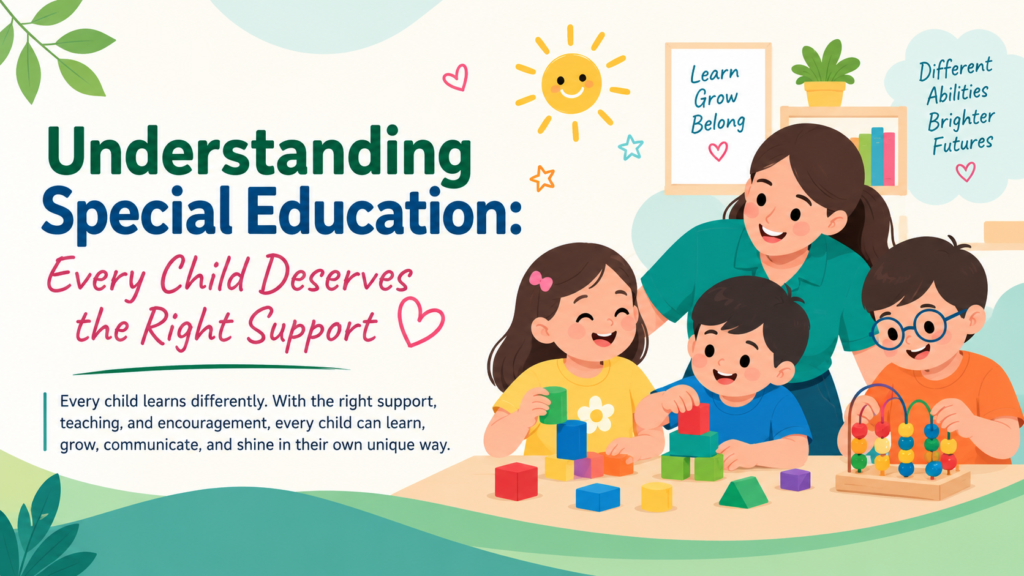
Understanding Special Education: Every Child Deserves the Right Support
Every child learns differently. Special education provides individualized support, practical learning strategies, and the right environment to help children learn, communicate, grow, and become as independent as possible.
Special education is not about separating children from society. It is about giving every child the opportunity to learn, grow, communicate, participate, and become as independent as possible through teaching methods that match their individual needs.
What is Special Education?
Special education is a customized educational approach created for children who have special needs. These needs may arise from conditions such as Autism Spectrum Disorder (ASD), Attention Deficit Hyperactivity Disorder (ADHD), Intellectual Disability (ID), Learning Disability (LD), Cerebral Palsy (CP), hearing impairment, visual impairment, speech and language disorders, or developmental delays.
In special education, teaching is adapted according to the child's individual strengths and requirements.
Why is Special Education Important?
Many children with special needs face difficulties in regular classroom settings. They may struggle with understanding instructions, sitting for long periods, interacting with peers, reading, writing, or managing daily activities. Without appropriate support, children may become frustrated or lose confidence.
Special education can help with:
Early intervention and special education can significantly support a child's future learning, behavior, participation, and overall quality of life.
Who May Benefit from Special Education?
A child may benefit from additional educational support if they experience difficulties in areas such as:
Assessment by special educators and relevant professionals such as psychologists, speech-language therapists, occupational therapists, and physiotherapists can help identify the child's strengths and areas where additional support may be useful.
Key Areas Covered in Special Education
Programs can address academic, communication, physical, social, emotional, and everyday living skills.
1. Communication & Language
Children are supported in understanding and expressing their needs through:
• Picture communication (PECS)
• Gestures and signs
• Vocabulary building
• Sentence formation
• Conversation skills
2. Academic Readiness
• Pre-writing skills
• Tracing lines and shapes
• Alphabet identification
• Number recognition
• Matching and sorting
• Reading simple words
• Basic mathematics
3. Fine Motor Development
• Threading beads
• Clay activities
• Coloring
• Finger painting
• Peg boards
• Cutting and pasting
4. Gross Motor Development
• Balance training
• Walking activities
• Jumping
• Ball activities
• Stair climbing
• Coordination exercises
5. Social & Emotional Skills
• Taking turns
• Sharing
• Greeting others
• Waiting
• Understanding emotions
• Playing with peers
6. Activities of Daily Living
• Feeding
• Toileting
• Dressing
• Brushing
• Bathing
• Organizing belongings
Effective Teaching Strategies
Individualized Education Plan (IEP)
Each child receives specific goals based on their abilities. Goals are reviewed and modified according to progress.
Multi-Sensory Teaching
Visual, auditory, movement, and hands-on methods are combined to make learning easier and more meaningful.
Task Analysis
Complex activities are broken into smaller, manageable steps so children can learn one step at a time.
Positive Reinforcement
Praise, stickers, tokens, or preferred activities can encourage participation, motivation, and desired behaviors.
Structured Routine
Predictable routines can help children understand what comes next and participate more confidently.
Visual Supports
Timetables, picture cards, first-then boards, and visual rules can support understanding and reduce uncertainty.
Role of Parents in Special Education
Parents are the child's first and most important teachers. Progress can be strengthened when therapy and educational strategies are practiced consistently at home.
Consistency between home and the learning environment is essential.
Importance of Early Intervention
The early years are an important period of development. Starting appropriate intervention early can support development in several areas.
✓ Speech and language
✓ Social skills
✓ Learning ability
✓ Behavior
✓ Independence
It Is Never Too Late to Learn
Early support can be valuable, but older children and adolescents can also continue learning and developing new abilities with individualized educational support, therapy, life-skills training, and vocational opportunities.
Beyond Academics: Preparing for Life
Special education is not only about reading and writing. It also focuses on helping children participate meaningfully in everyday life.
Pre-Vocational Activities
Activities such as candle making, painting, paper crafts, gardening, packing, and other structured tasks can help develop attention, responsibility, work habits, coordination, and greater independence.
Every Small Step Matters
Special education is a journey of understanding, patience, and empowerment. Every child has strengths, abilities, and the potential to learn when provided with appropriate teaching methods and support.
With early identification, individualized teaching, therapy support, and active parent involvement, children with special needs can make meaningful progress in communication, academics, behavior, participation, and daily living.
At GiftAbled Child Development Center, we believe that every child is unique, every small step matters, and every child deserves the opportunity to shine.
Special education is not about changing the child — it is about adapting the way we teach so that each child has the opportunity to succeed with confidence and dignity.